Last updated 2026-08-18
TL;DR
Texas issues no single "fountain service" license. You likely need a business registration, local permits, and a Texas Department of Agriculture pesticide applicator license if you apply algaecides. Startup costs run $3,000 to $15,000. Service visits price between $75 and $300 each. Municipal annual contracts range $3,000 to $12,000. This guide walks the actual paper path.
What is fountain service and who hires these companies in Texas?
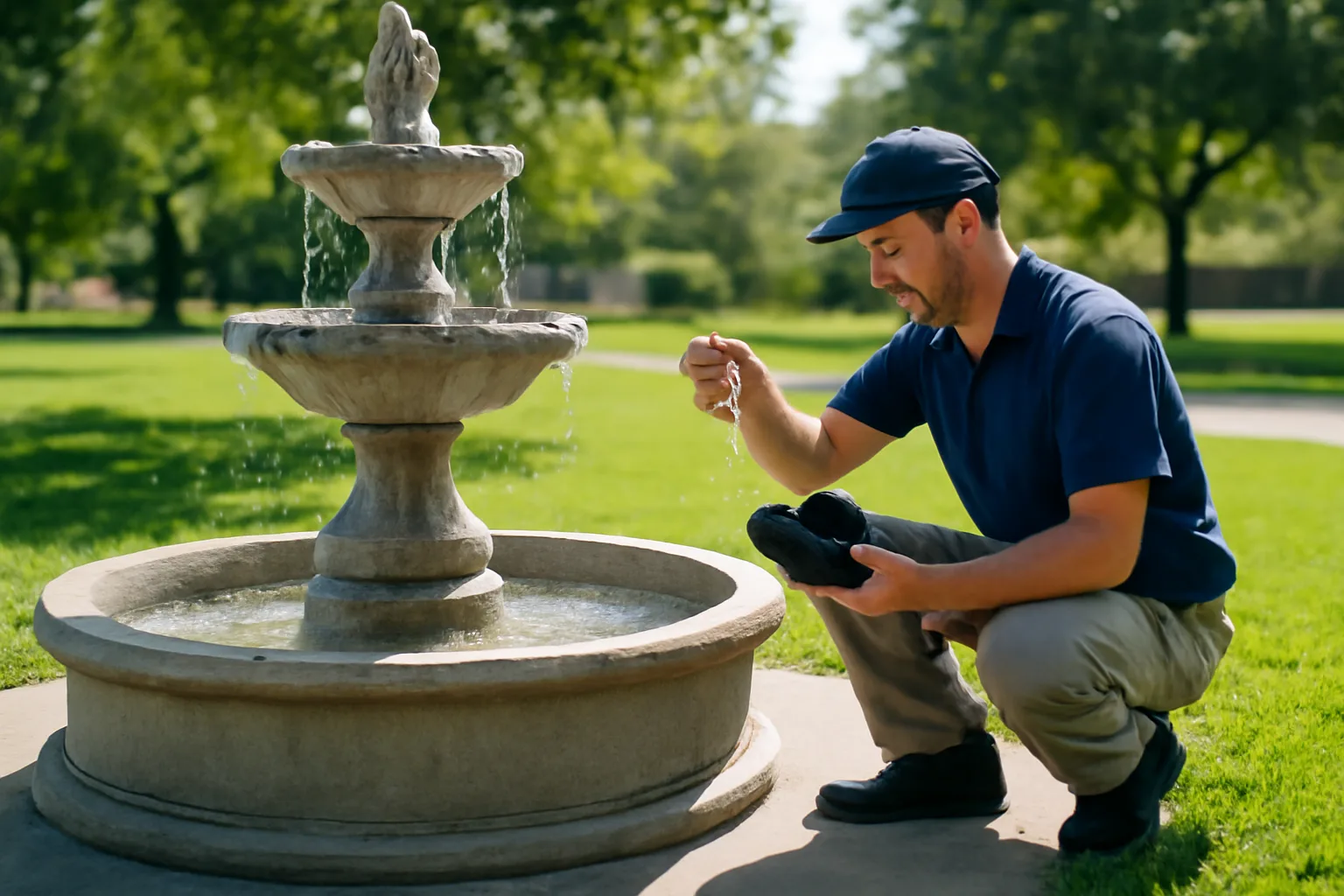
Fountain service is the cleaning, chemical balancing, mechanical maintenance, and winterization (yes, even in Texas) of decorative water features: HOA entrance fountains, municipal park displays, hotel lobbies, corporate campuses, and cemetery monuments. The work is more chemistry than plumbing. You manage algae, pH, calcium scaling, and pump wear on systems that run 24 hours a day and go very public the moment they fail.
The Texas customer base leans hard toward HOAs and municipalities. The state has thousands of active water-control and special utility districts, and many manage decorative water features inside parks and public spaces [1]. Add the large population of Texas homeowners associations, most of which sit under professional management companies that handle common-area features, and the serviceable market is big [2].
Private residential customers exist too. But the real money for a fountain company is recurring contracts. A single HOA entrance fountain might need monthly chemical service, quarterly mechanical inspection, and an annual drain-and-scrub. That stacks up fast on a route.
Do you need a license for fountain service in Texas?
There is no single license called a "fountain service license" in Texas. What you actually need depends on the tasks you perform.
Business registration: Any LLC, corporation, or LLP operating in Texas registers with the Texas Secretary of State [3]. A sole proprietor doing business under a name other than their own legal name files a DBA (Assumed Name Certificate) with the county clerk where they operate.
Pesticide applicator license: This is the one that catches people off guard. If you apply any product to control algae, mosquitoes, or other organisms in or around a water feature, Texas law treats that as commercial pesticide application. The Texas Department of Agriculture requires a Commercial Pesticide Applicator License for anyone paid to apply restricted-use or general-use pesticides commercially [4]. The relevant category is usually 5-B (Industrial, Institutional, Structural, and Health-Related Pest Control) or Category 9 (Regulatory Pest Control). You pass a written exam through TDA. Confirm the current exam fee and category structure on the TDA licensing pages before you register.
Contractor and plumbing work: If your fountain work touches plumbing connections (supply lines, drains, backflow preventers), the Texas State Board of Plumbing Examiners licenses that work, and doing it unlicensed is a violation [5]. Many fountain techs stay on the non-plumbing side and subcontract true plumbing to a licensed plumber. Know where that line sits.
Backflow preventer testing: Fountains fed from municipal water almost always require a backflow prevention assembly. Testing that assembly in Texas requires a TCEQ license or a licensed plumber. The Texas Commission on Environmental Quality regulates public water supply protection under 30 TAC Chapter 290 [6].
Local permits: Cities and counties add their own layer. Austin, Houston, Dallas, and San Antonio each have local business registration requirements. Some cities also require a home occupation permit if you run the business from a residence. Call the city clerk's office in your operating area before you spend money on anything else.
Here is the short version: plan for a business registration, a TDA commercial pesticide applicator license if you use algaecides, and local city or county permits. The rest depends on your service scope. Confirm with the relevant board before you assume any requirement applies or doesn't apply to your situation.
How much does fountain service cost in Texas?
Pricing in Texas tracks two things: local labor rates and the size of the feature. A small HOA tiered fountain and a large municipal basin are completely different jobs, and the bids show it.
Routine monthly chemical service on a standard two-tier residential or small HOA fountain generally runs $75 to $150 per visit across Texas. Quarterly mechanical inspections (pump checks, nozzle cleaning, light inspection) add $100 to $200 per event. Annual full-drain cleanings on HOA-scale features run $250 to $600 depending on water volume and access.
Municipal park fountains and large commercial displays are bigger scopes, priced as bids rather than flat rates. A full-service annual contract covering chemical service, mechanical inspection, and emergency response for a single large municipal feature can range from $3,000 to $12,000 per year. Nobody has clean aggregated data on this. These are bid contracts, and the numbers stay buried in procurement files.
The table below summarizes typical Texas market ranges by service type:
| Service Type | Typical TX Price Range | Frequency |
|---|---|---|
| Routine chemical balancing | $75 to $150/visit | Monthly |
| Mechanical inspection | $100 to $200/visit | Quarterly |
| Full drain and scrub | $250 to $600/job | Annual |
| Pump replacement (parts + labor) | $300 to $900/job | As needed |
| Municipal full-service contract | $3,000 to $12,000/year | Annual bid |
These ranges reflect market observation, not a formal price survey. Your real bids will move with your city, travel distance, feature complexity, and cost structure. Never copy a competitor's rate before you understand your own costs.
How long does fountain service take in Texas?
Two questions hide inside this one. How long does each visit take, and how long does licensing and startup take before your first paid job?
Visit duration: A routine monthly chemical service call on a small to mid-size fountain takes 45 minutes to 1.5 hours on site. That covers water testing, chemical dosing, a quick mechanical eyeball, and notes. A full annual drain and scrub on an HOA feature runs 3 to 6 hours depending on basin size and scale buildup. Large municipal jobs can be full-day events with a two-person crew.
Startup timeline: This is where Texas makes you plan ahead. The TDA Commercial Pesticide Applicator exam schedules through their system, and exam seats are not always open the week you decide to start. Allow 4 to 8 weeks from study start to exam date to license issuance. Business registration with the Texas Secretary of State typically processes in 3 to 5 business days for online filings [3]. Local permits vary: some process same-day online, others require in-person submission and take 2 to 4 weeks.
A realistic path from decision to first paid job is 6 to 12 weeks if you start the TDA process immediately. Delay the pesticide license and you could run mechanical-only work sooner, but you'd leave a big part of the service menu on the table.
What equipment do you need to start fountain service in Texas?
The core equipment list is shorter than most people expect. You do not need a service truck on day one, though it helps.
A basic startup kit includes a water test kit or digital meter (pH, ORP, conductivity), a wet/dry shop vacuum for bottom sediment, a submersible pump for draining, algaecide and clarifier chemistries matched to the feature type, basic hand tools (wrenches, pliers, wire brush), and transport containers for chemicals.
A minimal kit costs $800 to $2,500. A mid-grade setup with a dedicated service trailer, pressure washer, and digital water testing gear runs $8,000 to $15,000. Branded-truck operations with full chemical and backup pump inventory cost more, and you do not need that to start.
Texas heat matters here. Fountains in Austin or Houston scale faster and grow algae harder than fountains in cooler climates, so your chemical inventory has to account for it. Copper-based algaecides work well but can stain concrete over time. Enzyme-based products work better in features with fish or near permeable surfaces. You'll build preferences after a few months on the job.
One edge Texas operators report: keep a good UV clarifier or chemical feeder recommendation ready when clients ask about cutting service frequency. You're advising, more than cleaning.
What does business insurance for Texas fountain service actually look like?
You need general liability insurance before you touch a client's property. A fountain can crack, a chemical can stain a walkway, a pump can die a week after you service it. General liability at $1 million per occurrence is the floor most HOA contracts and all municipal contracts require.
For Texas fountain service, annual general liability premiums typically run $500 to $1,500 for a sole operator with no employees. Add commercial auto if you use a vehicle for the business. Add a tools and equipment floater if your gear is worth protecting in transit.
Municipal contracts in Texas often require $2 million aggregate coverage and want to be listed as additional insureds on your certificate. Get your certificate before you bid municipal work, because the procurement documents will ask for it up front.
Workers' compensation in Texas is optional for most private employers under Texas Labor Code Chapter 406 [7]. But if you have employees and skip it, you carry real financial risk, and many HOA management companies require proof of workers' comp regardless of the state's opt-out structure.
How do you land your first HOA or municipal fountain contract in Texas?
HOA contracts and municipal contracts follow different paths.
HOA contracts usually get decided by the property management company that runs the HOA. Big Texas managers include Associa, FirstService Residential, and CCMC, each managing thousands of communities statewide. Getting on their approved vendor list means a current certificate of insurance, proof of any required licenses, and often a W-9. Cold outreach to regional managers is the most direct route. HOA contracts frequently skip formal competitive bidding, so relationships carry weight.
Municipal contracts in Texas go through formal procurement. Cities publish Requests for Proposals (RFPs) or Requests for Qualifications (RFQs) on their purchasing portals. The Texas Comptroller's Electronic State Business Daily (ESBD) lists state agency opportunities [8]. Many cities also run their own vendor portals (Austin, Houston, Dallas, San Antonio each have separate systems). Register on every portal covering your service area.
Small cities and special utility districts often run informal bids. Show up to a parks department meeting, introduce yourself, leave a one-page capability statement. Smaller municipalities often have no incumbent and are genuinely looking.
For state-specific paper path requirements beyond the basics, WinterizePath's Municipal + HOA Fountain Kit at /start organizes the documents, contract templates, and checklist your first procurement package needs. One-time cost is $149.
You can also study how neighboring states handle similar licensing. The how to start fountain service in arizona and how to start fountain service in colorado guides show the western regional pattern, which Texas partially mirrors in its contractor registration approach.
What are the Texas TCEQ rules that affect fountain service operators?
The Texas Commission on Environmental Quality is the agency that matters most to you after TDA. Two TCEQ areas touch fountain service directly.
First, water quality and discharge. If you drain a fountain to a storm drain, that water cannot carry chemical concentrations that violate local MS4 (Municipal Separate Storm Sewer System) permits. Most Texas cities operate under TCEQ-administered MS4 permits [6]. The practical takeaway: do not dump heavily chemicated fountain water into a street drain. Discharge to a sanitary sewer (with property owner permission and sometimes a local sewer authority pre-approval) or let the water dissipate into landscaping away from paved surfaces.
Second, backflow prevention. TCEQ requires licensed backflow prevention assembly testers under the public water supply rules in 30 TAC Chapter 290 [6]. If you plan to test these devices yourself (required annually on most commercial and municipal systems), get licensed or subcontract to someone who is. Adding that certification is real recurring revenue.
TCEQ runs no separate "fountain service" license. But your operations sit in their jurisdiction any time water leaves your work site or enters a municipal supply line.
What does a Texas fountain service business look like financially in year one?
Let's be honest about year one. Most operators spend six months building a route before the income feels real.
A realistic first-year picture for a solo Texas operator:
- Startup costs: $3,000 to $8,000 (equipment, licenses, insurance, registration fees, initial chemical inventory)
- Monthly recurring contracts by month 6: 8 to 15 HOA or commercial accounts
- Revenue per account per year: $900 to $3,600 (varies hugely by service scope)
- Year-one gross revenue: $12,000 to $40,000 for a part-time ramp, $35,000 to $80,000 for a full-time push
The operators who hit profitability fastest chase recurring contracts, not one-off cleanings. One annual drain job is fine. Twelve monthly service agreements are a business.
Texas has no individual income tax, which helps on the personal side [9]. You'll still owe federal self-employment tax on net profit. Set aside 25 to 30% of net income for taxes in year one until you know your effective rate.
For contrast, the how to start fountain service in california guide shows a higher-regulation, higher-cost state. Texas is meaningfully easier on licensing and cheaper on labor, but California's per-visit pricing also runs higher, so the tradeoffs cut both ways.
What common mistakes do new Texas fountain service operators make?
A few patterns show up again and again.
The biggest: skipping the TDA pesticide license and applying algaecides anyway. TDA does investigate complaints, and fines for unlicensed commercial pesticide application start at $250 per violation and climb for repeat violations [4]. The risk isn't worth it, and the license is not hard to get.
Second mistake: signing HOA contracts without reading the terms. Some management companies slip in clauses that make you liable for any property damage during your service window, including pre-existing cracks the fountain already had. Document the condition of every feature before you start. Photos are your protection.
Third: underpricing to win the first contract and getting stuck. Texas customers expect price increases to stay modest and justified. Price a first year at $80/month when your real cost is $95/month and you've built a problem you can't easily fix. Price for your real costs from the start, even if it costs you a few early bids.
Fourth: ignoring the municipal procurement calendar. Cities often lock service contracts in October or November for the following year. Start reaching out in February and you're bidding into a cycle that already closed. Learn the fiscal-year calendars for your target cities and start outreach 90 days before their budget cycle ends.
The how to start fountain service in arkansas guide covers adjacent-state procurement timing that applies to East Texas operators bidding across state lines.
Where do you register and what are the specific Texas agency links you need?
Here are the starting points for each registration step.
Texas Secretary of State for business entity registration. LLC formation runs $300 as of the current published fee schedule; confirm before filing [3].
Texas Department of Agriculture for Commercial Pesticide Applicator licensing. Exam scheduling, study guides, and fee schedules all live on the TDA site [4].
Texas State Board of Plumbing Examiners if your scope includes plumbing connections [5].
TCEQ for backflow prevention tester licensing and water quality rules [6].
Texas Comptroller ESBD for state and local government bid opportunities [8].
For local city permits, go directly to each city's development services or permitting department. There is no single statewide portal for local permits.
WinterizePath's Municipal + HOA Fountain Kit at /start compiles the document checklist, sample contract language, and procurement templates that help you walk into a first municipal bid meeting prepared. It does not replace agency confirmation of current fees or requirements. It organizes what you need to gather.
For a look at how licensing works in a neighboring state, the fountain service license in arizona guide is the closest analog to the Texas regulatory structure.
Frequently asked questions
Do you need a license for fountain service in Texas?
Texas has no specific fountain service license. You need a business registration with the Secretary of State or county clerk, a Texas Department of Agriculture Commercial Pesticide Applicator License if you apply algaecides or other chemicals, and local city or county business permits. If your work involves plumbing connections, State Board of Plumbing Examiners requirements also apply. Confirm current requirements with each agency before starting.
How much does fountain service cost in Texas?
Routine monthly chemical service runs $75 to $150 per visit. Quarterly mechanical inspections add $100 to $200. Annual full-drain cleanings on HOA-scale features run $250 to $600. Municipal full-service annual contracts for large features range from $3,000 to $12,000. Prices vary by city, feature size, and your cost structure. Larger metros like Austin and Houston tend toward the higher end.
How long does fountain service take in Texas?
A routine chemical service visit takes 45 minutes to 1.5 hours on site. A full annual drain and scrub runs 3 to 6 hours. For startup, allow 6 to 12 weeks from decision to first paid job: the Texas Department of Agriculture pesticide applicator exam takes 4 to 8 weeks to schedule and pass, and business plus local permits add 1 to 4 weeks depending on the city.
Does Texas require a pesticide license to apply algaecide in a fountain?
Yes. Texas law requires a Commercial Pesticide Applicator License from the Texas Department of Agriculture for anyone paid to apply pesticides, including algaecides, commercially. Confirm the current exam fee per category on the TDA site before registering. Operating without this license carries fines starting at $250 per violation.
Can I start fountain service in Texas as a sole proprietor without forming an LLC?
Yes. A sole proprietor in Texas can operate without an LLC. If you use a business name other than your own legal name, file a DBA (Assumed Name Certificate) with the county clerk. Many operators still form an LLC for liability protection, especially once they work on municipal or HOA properties where a contract dispute or property damage claim is possible. The LLC filing fee with the Secretary of State is $300.
What insurance does a Texas fountain service company need?
General liability at $1 million per occurrence is the standard minimum, and most HOA and municipal contracts require it. Annual premiums for a solo operator run $500 to $1,500 depending on coverage limits and insurer. Municipal contracts often require $2 million aggregate and want to be listed as additional insureds. Commercial auto and tools coverage round out a basic package.
Does Texas have rules about where you can drain fountain water?
Yes. Under TCEQ's Municipal Separate Storm Sewer System (MS4) permit program, draining chemicated fountain water to a storm drain can violate local MS4 permits in most Texas cities. The practical approach is to discharge to a sanitary sewer with property owner permission or let the water infiltrate landscaping away from paved surfaces. Confirm local discharge rules with your city's stormwater department.
How do you find HOA fountain service contracts in Texas?
The main path runs through property management companies like Associa, FirstService Residential, and CCMC, which manage thousands of Texas HOAs. Get on their approved vendor lists with a current certificate of insurance, license documentation, and a W-9. HOA contracts rarely go through formal competitive bidding, so direct outreach to regional managers and referrals from board members are your best tools.
How do you bid on municipal fountain service contracts in Texas?
Texas cities publish RFPs and RFQs through their own purchasing portals and the Texas Comptroller's Electronic State Business Daily (ESBD). Register as a vendor on the ESBD and on portals for Austin, Houston, Dallas, San Antonio, or any city in your service area. Municipal contracts require current insurance certificates and license documentation. Start outreach 90 days before a city's budget cycle closes, typically October or November.
Do Texas fountain service operators need a backflow preventer testing license?
If you want to test backflow prevention assemblies yourself, yes. TCEQ licenses backflow prevention assembly testers under 30 TAC Chapter 290, and most commercial and municipal water systems require annual testing. Many fountain operators subcontract this to a licensed plumber or tester. Adding the certification yourself creates a recurring revenue stream on top of your base service work.
What is the startup cost to open a fountain service business in Texas?
A minimal startup with basic equipment, licenses, and insurance runs $3,000 to $8,000. A mid-grade setup with a trailer, pressure washer, and digital testing equipment runs $8,000 to $15,000. Startup costs include the LLC filing ($300), the TDA pesticide applicator exam fee, general liability insurance ($500 to $1,500/year), and equipment ($800 to $10,000 depending on what you buy). Local permits add $50 to $300 depending on the city.
How many fountain service accounts do you need to be profitable in Texas?
A solo operator covering their own salary and business costs typically needs 10 to 20 recurring monthly accounts within the first year, assuming $100 to $200 per account per month. That generates $12,000 to $48,000 in annual recurring revenue before one-off jobs and annual cleanings. Profitability depends heavily on route density: clustered accounts in one area cost far less to service than scattered accounts across a metro.
Is fountain service seasonal in Texas?
Less seasonal than in northern states, but not immune. Most Texas fountains run year-round, which means steady recurring revenue. Winter cold snaps, especially in North Texas, can cause freeze damage that drives emergency service calls. Some clients in colder parts of the state shut features down from December through February. South Texas fountain service is essentially year-round with minimal slowdown.
What Texas agency handles complaints about unlicensed pesticide application?
The Texas Department of Agriculture handles complaints and enforcement for unlicensed commercial pesticide application. Fines for violations start at $250 and climb for repeat violations. TDA investigates based on complaints and periodic inspections. A competitor or client complaint is the most common trigger. The safest position is to have your license in hand before you apply any chemical product commercially.
Sources
- Texas Commission on Environmental Quality, Districts: Thousands of active water control and special utility districts operate in Texas, many managing public water features.
- Texas Comptroller of Public Accounts: Texas has a large population of active homeowners associations, many of which manage common-area water features.
- Texas Secretary of State, Business Organizations Filing Fees: LLC formation in Texas requires filing with the Secretary of State; the standard filing fee is $300.
- Texas Department of Agriculture, Pesticide Programs: Texas requires a Commercial Pesticide Applicator License from TDA for anyone paid to apply pesticides commercially, including algaecides; fines for violations start at $250 per violation.
- Texas State Board of Plumbing Examiners: Texas requires licensure from the State Board of Plumbing Examiners to perform plumbing work, including connections to supply lines and drains on water features.
- Texas Administrative Code, Title 30, Part 1, Chapter 290 (Public Drinking Water): TCEQ regulates backflow prevention assembly testing and public water supply protection affecting fountain service operators under 30 TAC Chapter 290.
- Texas Department of Insurance, Workers' Compensation: Workers' compensation insurance is optional for most private employers in Texas under Texas Labor Code Chapter 406, but non-subscription carries significant financial risk.
- Texas Comptroller of Public Accounts, Franchise Tax: Texas has no individual state income tax; businesses may be subject to franchise tax depending on revenue thresholds.