Last updated 2026-08-18
TL;DR
Fountain service in California needs a local business license. Any job over $500 in labor plus materials also needs a CSLB contractor license, usually C-61/D-35 or C-27. Cleanings run $150 to $300 (HomeAdvisor national data), repairs $200 to $400, with California prices often 20 to 30 percent higher. Company labor rates run $50 to $100 per hour. Most visits take one to three hours.
Do you need a license for fountain service in California?
For basic maintenance like scooping debris, scrubbing surfaces, and testing water chemistry, you do not need a statewide contractor license. The Contractors State License Board (CSLB) requires a license only when a project, labor plus materials, tops five hundred dollars [1]. Clean a fountain for $400 and skip the plumbing and electrical, and you can operate on a local business license alone. Most cities and counties want that license, and you can check your city's rules through the CalGold portal [2].
The moment your work includes pump repair, pipe work, or any construction-like change, you cross $500 fast. Now you need a CSLB license. The best-fit classification for fountain work is C-61/D-35 (Pool and Spa Maintenance), since fountains share the same pump, filtration, and water treatment needs as pools. Landscapers who also service fountains often carry a C-27 Landscaping Contractor license. Both require a trade exam, a law exam, and four years of journey-level experience. Hiring a company? Verify the license number on the CSLB site. Starting the business yourself? Don't skip the license if your jobs will keep topping $500. The CSLB fines unlicensed contractors and can file misdemeanor charges.
Every California business forming an LLC or corporation registers with the Secretary of State [6], and almost every city requires a business license. Sell chemicals or replacement parts and you need a seller's permit from the California Department of Tax and Fee Administration (CDTFA) [5]. None of this is fountain-specific. New operators overlook it constantly.
How much does fountain service cost in California?
Flat-rate cleaning and repair quotes are the common pricing structure. HomeAdvisor's national data puts fountain cleaning at $150 to $300 per visit and fountain repair at $200 to $400, with a typical repair invoice near $290 [4]. California's cost of living pushes those bands up 20 to 30 percent in most metros, so a straightforward cleaning in San Diego or Los Angeles might run $200 to $400 instead. Many companies tack on a truck or travel fee of $50 to $100.
Hourly labor sits under those flat rates. The U.S. Bureau of Labor Statistics reports a mean hourly wage of $18.76 for California landscaping and groundskeeping workers, with a median of $17.99 (May 2023) [3]. The rate a company charges you covers far more than wages. It carries fuel, insurance, chemicals, and tool wear. Expect quoted service rates of $50 to $100 an hour. A two-hour cleaning might land as a $150 hourly bill or a $200 flat-rate job.
Materials add to the invoice. Algaecide, scale remover, pH balancers, and replacement sealants run $25 to $75 per visit. Need a new pump or an LED light kit? That's repair territory, and parts plus labor push the total past $400 quickly. Companies offering monthly or quarterly contracts usually discount the per-visit rate 10 to 15 percent for the guaranteed schedule.
The chart below uses BLS data to show how worker wages spread across California. Even at the 90th percentile, labor alone isn't the big line item. Overhead is.
How long does fountain service take in California?
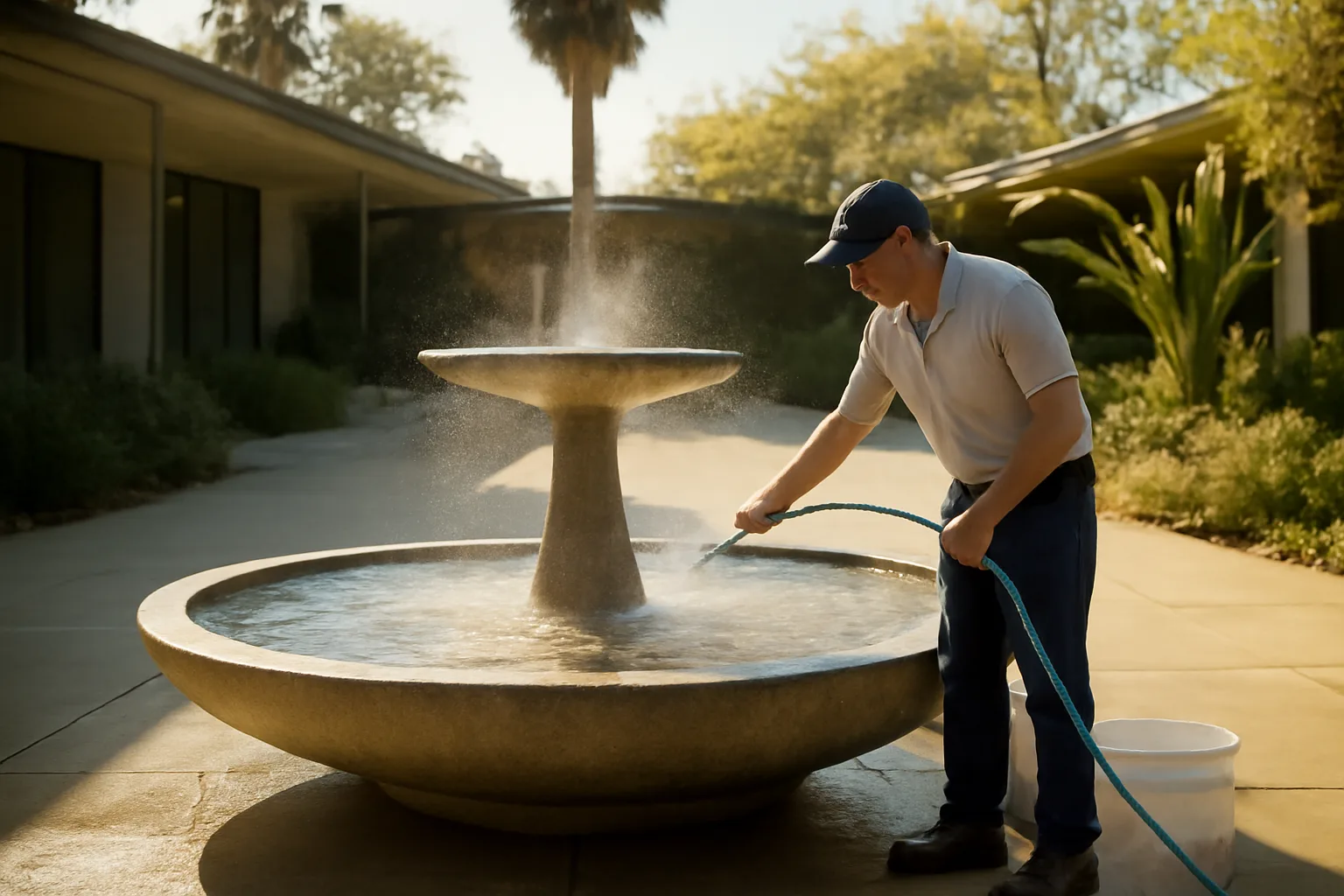
A standard cleaning for a residential or small commercial fountain takes one to three hours, covering draining, scrubbing, checking the pump basket, and refilling. Big architectural fountains or ones caked with calcium can eat half a day. Water testing and chemical balancing add about 30 minutes, assuming the fountain holds under a thousand gallons.
Repairs are all over the map. A pump swap might take an hour on site. A cracked basin can force a return visit after a bonding compound cures, stretching the job across two days. When you schedule, ask for on-site time plus any cure or setup intervals.
Booking lead times move with the season. In Southern California, where fountains run year-round, good companies often show up within a few days in winter but may need two weeks in July. Northern California runs a shorter peak (April through October), and availability tightens in late spring. Book maintenance in the off months and you usually get better prices and a faster response.
Business registration and local permits for fountain service in California
Past the contractor license question, every fountain service business in the state needs a local business license from the city or county where it works. CalGold pulls up which forms your city wants, plus any home-occupation permit if you run the business from home [2]. Filing a fictitious business name (DBA) with the county clerk is required if the business name isn't your legal name.
Selling fountain chemicals, replacement pumps, or even UV bulbs usually triggers a seller's permit. CDTFA Publication 73 says any tangible personal property sold in California is generally taxable, so you collect and remit sales tax [5]. Provide labor only, and hand the customer nothing physical, and you might dodge the permit. That line is thin. Most providers end up handing over algaecide tablets or new gaskets, and the CDTFA expects a permit for that.
Environmental rules show up too. Fountains that drain into a storm sewer may need a National Pollutant Discharge Elimination System (NPDES) permit if the chemicals you use can harm waterways. Check with your Regional Water Quality Control Board before you send chemically treated water into a street drain.
What factors influence fountain service cost in California?
Size and access are the two biggest cost drivers. A tabletop fountain you carry to a sink adds zero labor complexity. A three-tier courtyard fountain with steep access needs ladders, sump pumps, and extra time. Fountains with detailed tile or copper finishes need gentle cleaners that cost more and take longer to apply.
Water quality drives how much chemical you burn and how often the fountain needs service. In hard-water zones like the Inland Empire or parts of the Central Valley, calcium scale demands acidic cleaners and more frequent de-scaling visits. Along the coast, salt air corrodes metal parts, pushing repair frequency up around 20 percent versus inland locations.
Travel distance flows straight into the quote. A company based in metro Los Angeles adds a fuel surcharge to reach Malibu or Thousand Oaks. Some set a flat service radius (20 miles) and charge a per-mile rate beyond it. Compare quotes across states and you'll see fountain service in Georgia or Arizona often carries smaller travel premiums because their metros are more compact. California's sprawl can add $30 to $60 in trip fees.
Hiring a fountain service professional in California: what to look for
Start with the CSLB license check if the job will cross $500. Search by name or license number on the CSLB site for free. Confirm the license is active and the classification covers fountain work. C-61/D-35 is the obvious fit, but a C-27 landscaping contractor with pump repair experience works too.
Insurance is not optional for you as the customer. Ask for a certificate of insurance showing general liability (at least $1 million per occurrence) and workers' compensation if they have employees. Without workers' comp, you could be on the hook if a worker gets hurt on your property.
Read reviews for water feature knowledge, not generic landscaping praise. A one-person shop with three years of fountain-only work often beats a large hardscape company that treats fountains as an afterthought. Ask for references from clients with fountains like yours. Shopping on price alone is risky, because the lowest bidder often skips post-cleaning water balancing, and you get an algae bloom within a week.
DIY vs. professional fountain maintenance: cost and effort
Doing your own cleaning and water treatment drops the cost to materials plus your time. Algaecide, test strips, and scale remover for a typical backyard fountain run $30 to $60 a month if you buy in bulk. The BLS median wage for landscape workers ($17.99 per hour) gives you a way to price your own labor. If a full cleaning takes two hours a month and you earn more than that at your day job, hiring a pro can pencil out.
The hard parts of DIY are winterization, pump storage, and diagnosing electrical failures. One shortcut is a pre-packaged kit with the winterization supplies and step-by-step instructions. WinterizePath's $149 Municipal + HOA Fountain Kit bundles the drain equipment, antifreeze, and cover materials for a safe shutdown. It won't replace a pro for a cracked pump, but it kills the repeated trial-and-error purchases that add up past the kit price.
Go fully DIY and you still obey local discharge rules. Never drain chlorine- or algaecide-laced water into a storm drain. Most California counties want that water sent to a sanitary sewer or a landscape area where it can't reach a waterway.
How a fountain service kit changes the long-run cost math
A well-built fountain service kit works like an operating manual you can hold. It turns annual winterization and quarterly deep cleans into repeatable steps you or a handyman follows without guessing which chemical goes where. The $149 WinterizePath kit pays for itself the first time you dodge a $350 emergency plumbing repair from a freeze crack.
Comparing provider quotes? Ask whether the fee includes the same materials a kit would supply. Many $300-per-visit services list chemicals as a line item you could provide yourself, shaving $50 to $75 off each invoice. A kit doesn't make you an electrician, but it covers the straightforward mechanical and chemical tasks that eat billable service hours. For municipal or HOA managers running multiple water features, standardizing on one kit across sites cuts technician training time and per-fountain supply runs.
Regional cost variations across California
The Bay Area tops the price curve. Cleaning quotes in Palo Alto or San Francisco often land at $350 to $500 because labor, gas, and commercial rent for the service company all run high. Sacramento and the Central Valley sit closer to national averages, with cleanings often $180 to $280. Los Angeles and Orange County fall in between, roughly $250 to $400, while San Diego tracks L.A. minus 5 to 10 percent.
Coastal versus inland matters too. A fountain in Santa Monica needs more frequent service to fight salt corrosion, which pushes annual cost up. Inland, the same fountain might need quarterly visits for scale removal instead. Pricing a fountain path across states, you'll see the same patterns: Colorado fights freeze/thaw cycles that raise seasonal repair rates, while Florida fights year-round algae that raises chemical costs but cuts freeze damage. California runs from desert to alpine, so your ZIP code matters more than any statewide average.
Frequently asked questions
Do you need a license for fountain service in California?
Basic cleaning and maintenance under $500 per job (labor and materials combined) needs no statewide contractor license. Once a project tops $500, you must hold a CSLB license, usually C-61/D-35 or C-27. Every business needs a local city license. Sell parts or chemicals and you also need a CDTFA seller's permit.
How much does fountain service cost in California?
Cleaning typically costs $150 to $300 nationally, with California prices often 20 to 30 percent higher, landing at $200 to $400 per visit. Repairs run $200 to $400, and complex jobs go higher. Company hourly rates run $50 to $100, while the underlying worker wage averages $18.76 per hour.
How long does fountain service take in California?
A basic cleaning takes one to three hours. Chemical balancing adds about 30 minutes. Repairs can stretch to four hours on site, not counting cure time. Scheduling lead times run one to fourteen days, longest during summer when demand peaks.
What is the cheapest way to maintain a fountain in California?
Doing your own testing, cleaning, and winterization with a standard kit cuts annual maintenance to under $200 in materials, versus $1,200 to $2,400 for quarterly professional visits. Just make sure you follow local water discharge rules when you drain the basin.
Can I do fountain service myself without a license?
Yes, for your own property or a friend's fountain where you aren't charging. If you charge and the job stays under $500 per project, no contractor license is needed, but you still need a business license. Above $500, unlicensed contracting is illegal and carries fines.
What permits are needed to start a fountain service business in California?
A city business license, a seller's permit if you sell chemicals or parts, and a DBA filing if you don't use your own name. Exceed $500 jobs and you need a CSLB contractor license. Home-based businesses may also need a home occupation permit.
How do I find a reliable fountain service company in California?
Check CSLB license status for any company claiming contractor-level work. Ask for proof of general liability and workers' comp insurance. Read reviews focused on fountain expertise, and request references from clients with similar water features. Don't choose on price alone.
Are there seasonal pricing differences for fountain maintenance?
Yes. In winter, when demand drops, many companies discount routine cleaning 10 to 15 percent to keep crews busy. Spring and summer are peak, so you may pay a premium and wait longer. Booking winter maintenance in the fall can lock in lower rates.
What's the average hourly rate for a fountain service worker in California?
BLS data for landscaping and groundskeeping workers shows a mean of $18.76 per hour in California, with a median of $17.99. The 10th percentile is $14.63 and the 90th percentile is $26.08, which gives you the labor cost range before overhead.
Does fountain service insurance cost a lot in California?
General liability for a small fountain service business typically starts around $500 to $800 per year. Workers' comp can add $1,500 to $3,000 annually, depending on payroll and risk classification. It's a real expense, and not optional for you as a customer to verify.
How do California fountain service costs compare to other states?
California runs 20 to 40 percent above the national average on living expenses and fuel. Compared to Arizona, where labor is cheaper, a cleaning visit often costs $50 to $100 more in California. Coastal corrosion also raises repair frequency.
Sources
- CSLB, When Do You Need a Contractor's License?: $500 threshold triggers contractor license requirement; C-61/D-35 and C-27 are relevant classifications.
- CalGold permit assistance portal: CalGold provides city-specific business license and permit requirements for any California location.
- Bureau of Labor Statistics, May 2023 State Occupational Employment and Wage Estimates, California, Landscaping and Groundskeeping Workers: California mean hourly wage $18.76, median $17.99, percentiles from $14.63 to $26.08.
- HomeAdvisor, How Much Does It Cost to Repair a Fountain?: National average fountain repair $290, typical range $200-$400; cleaning ranges $150-$300.
- CDTFA, Publication 73, Your California Seller's Permit: Selling tangible items like chemicals or parts in California requires a seller's permit and sales tax collection.
- California Secretary of State, Starting a Business: Businesses forming an LLC or corporation in California must register with the Secretary of State.