Last updated 2026-08-18
TL;DR
Arkansas has no fountain service board and no state license for routine fountain cleaning and pump checks on private property. A contractor license enters only when the job crosses Arkansas contractor thresholds, and plumbing or electrical work needs its own license. Basic residential service runs roughly $100 to $300 per visit and takes one to two hours. Commercial drain-and-refill or winterization can run four to eight. Confirm local permits.
What is the Arkansas fountain service board?
There isn't one. Arkansas has no state agency called the Fountain Service Board, no fountain service contractor license, and no section of the Arkansas Code that creates a board for decorative water features. That surprises people, because most states with heavy contractor licensing still don't name a fountain board either. The closest state bodies are the Arkansas Contractors Licensing Board, the Board of Electrical Examiners, and the Department of Health's plumbing program [1][3][4].
State law says: "No person shall engage in business as a contractor unless he or she has been issued a license under this chapter by the Contractors Licensing Board" [1]. That quote matters because it's the first wrong turn new fountain operators make. They go looking for a board that licenses fountains, don't find one, and assume no rule applies. The real answer is narrower. No fountain board exists, but broad contractor and trade rules can still reach you.
When a client asks for your Arkansas fountain service board number, there isn't one to show. What you can show instead is a business license, the trade license number of any plumber or electrician on the job, a written scope, and proof of insurance. That usually satisfies a reasonable property manager.
Do you need a license for fountain service in Arkansas?
No, not for routine fountain cleaning, chemical balancing, debris removal, or pump and nozzle checks on private property. Arkansas does not issue a stand-alone fountain service license, and state law does not list fountain service as a contractor activity unless the project meets a broader contractor definition [2]. The closer you get to construction, plumbing, electrical, or potable water, the more likely a separate license or permit attaches.
Doing new construction over the commercial contractor threshold? You need an Arkansas Contractors Licensing Board license [1][8]. Touch potable water piping, and a plumbing license applies [3]. Run new line voltage, and an electrical license applies [4]. A pure service visit that stops at the fountain bowl and the cord-connected pump is the safest spot in the state from a licensing standpoint.
I'd treat pure service as unlicensed at the state level, but confirm your city and county requirements, because local privilege fees and business license rules differ. One local call can keep a bad first invoice from turning into a stop-work order.
When does the Arkansas Contractors Licensing Board get involved?
The Arkansas Contractors Licensing Board licenses contractors under a broad definition. A contractor includes someone who bids or does construction, alteration, repair, improvement, or demolition work on a building or structure [2]. A fountain is usually a structure or an improvement, so a newly built commercial fountain or a major remodel can be a contractor project.
The commonly cited threshold for commercial work is $50,000 including labor and materials. Stay below that and you're likely outside the board's normal license trigger [8]. Routine fountain jobs almost always stay below it. A pump replacement, a basin clean, a winterization, and a light check are not a $50,000 construction project.
If a general contractor hires you as a sub on a larger fountain install, the general's license may cover the project, but that does not license you to do electrical or plumbing. Those licenses stay separate. That's the part people miss on municipal fountain rebuilds.
Plumbing, electrical, and water supply rules for fountain work
The Arkansas Department of Health regulates plumbing and natural gas licenses. If the job connects a fountain to a potable water supply, adds an auto-fill line, or alters drain piping, use a licensed plumber [3]. Many municipal and commercial fountains also trigger backflow or cross-connection rules, because fountain water sits and can contaminate the supply. Arkansas runs a cross-connection control program that requires appropriate backflow prevention [10].
Electrical work is licensed through the Arkansas Board of Electrical Examiners [4]. A typical service visit swaps a pump. If the pump is cord-and-plug connected and you're only unplugging or replugging a listed pump, that often stays outside the state electrical permit system. But hard-wiring a pump, adding a panel circuit, or repairing line-voltage lights is not general maintenance. Use a licensed electrician, and pull the permit the city requires.
My rule is simple. If the work requires shutting off a water supply at the wall or touching anything inside an electrical enclosure, stop and bring the right license. It costs more on paper. It costs less than doing it wrong.
Local permits and business licenses for fountain work in Arkansas
Arkansas leaves business licensing to cities and counties. Little Rock requires a city business license for anyone doing business in the city, and other cities have similar privilege license or business registration rules [6]. The state also requires entity registration if you form an Arkansas LLC, corporation, or partnership [7]. None of these are fountain service licenses, but they are the paper a client will often ask for.
Some cities or water utilities also require a plumbing or electrical permit for fountain installation, especially when it involves an auto-fill or a dedicated circuit. The city clerk and the building inspections department are the two calls to make before you quote a commercial fountain install. Ask directly: "Do I need a city business license, and will this fountain need a plumbing or electrical permit?" Write down who you spoke to and the date.
This is where Arkansas fountain service goes sideways for new operators. They think that because there's no state board, there's no paper at all. The local permit is often the paper that exists.
How much does fountain service cost in Arkansas?
Arkansas does not publish a state fountain service fee schedule. Providers set their own prices. National cost data puts basic fountain repair between $150 and $450, with simple cleaning visits often lower, around $100 to $300 [5]. HomeGuide's national guide says "fountain repair costs $150 to $450" [5]. That matches the Arkansas quotes I'd expect: a small private fountain visit in central Arkansas usually runs $150 to $300, and a pump replacement often lands between $250 and $450 including the part.
Annual HOA or municipal contracts run higher because they cover multiple visits, water chemistry, and recordkeeping. Budget $1,200 to $3,600 per fountain per year for a small to midsize feature. Large interactive municipal fountains go much higher.
| Work | Typical range | Notes |
|---|---|---|
| Basic service visit | $100 - $300 | private, one tech, no parts |
| Pump replacement | $150 - $450 | labor and pump, national range |
| Seasonal winterization | $150 - $350 | drain, blowout, protect equipment |
| Annual HOA or municipal contract | $1,200 - $3,600 | per feature, frequency-driven |
Get a fixed price for the first clean. Walk away from a company that quotes a fountain service without looking at the pump or the water condition.
What gets included in a typical Arkansas fountain service visit?
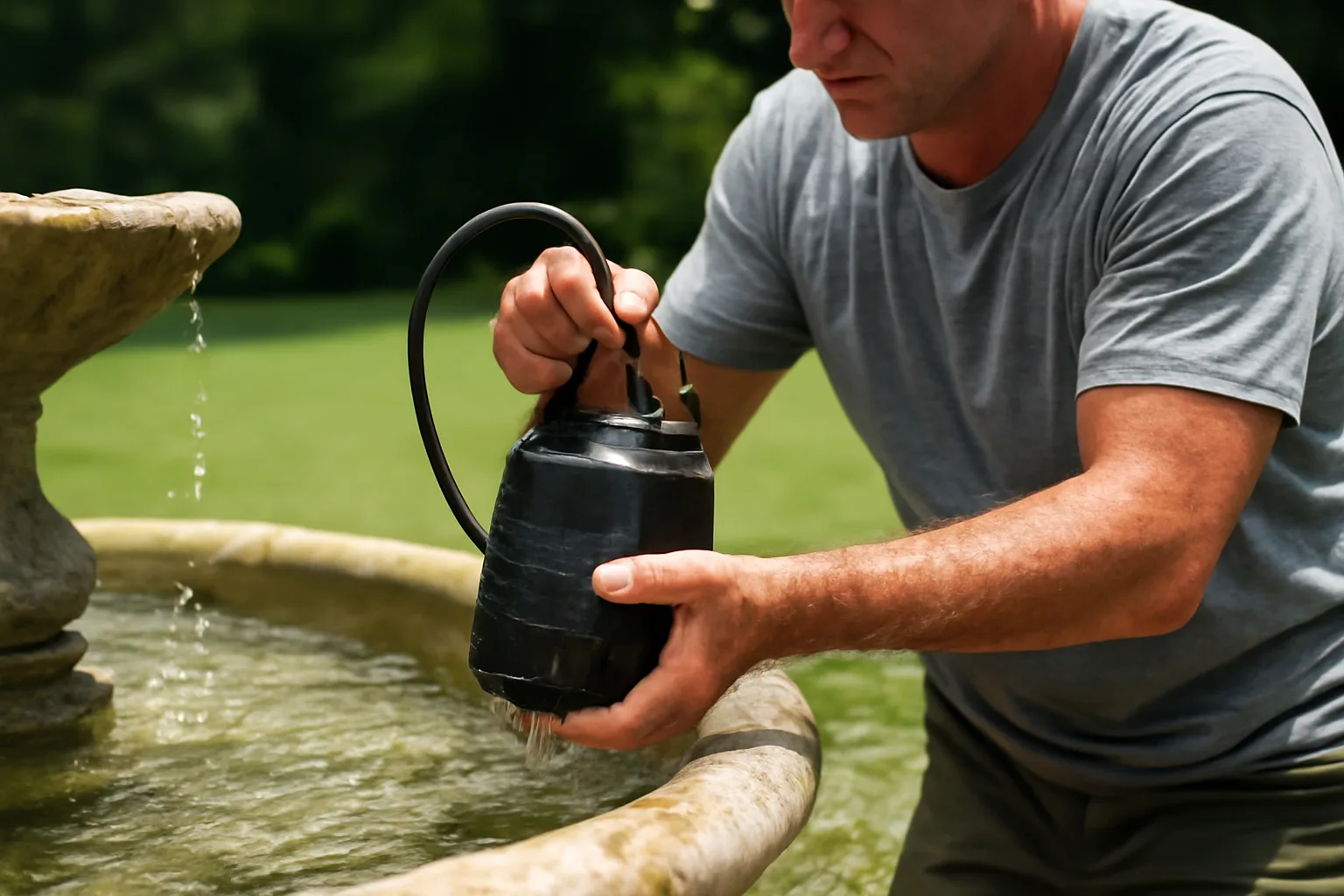
A competent basic visit includes skimming leaves and debris, cleaning the pump intake and impeller, checking water level and auto-fill, testing GFCI protection if the pump is cord-connected, cleaning or replacing the pump pre-filter, adding algaecide or clarifier if the owner wants chemical treatment, and running the pump long enough to verify flow. On larger fountains, the tech should pull the pump, inspect the volute, check lighting, and open the vault.
OSHA's standard applies to "permit-required confined spaces" [9]. Some large underground fountain vaults meet that standard, which means a municipal tech should carry a written entry plan, a gas monitor, and an attendant. If the crew won't open the vault, don't assume it's fine. An HOA fountain with an electric panel in a sunken vault is not the same job as a patio fountain.
In Arkansas heat, summer service is less about freeze and more about circulation and water loss. A good tech checks the auto-fill float, the overflow, and the pump's running current on every visit. That catches most failures before the pump burns out.
How long does fountain service take in Arkansas?
No Arkansas board sets a service-time rule. A routine residential visit takes 45 minutes to two hours, depending on the pump and water condition. A first call on a neglected fountain may run longer, because you have to clean the intake, pull hair and string off the impeller, and check the basin.
A full drain, pressure wash, and refill on a commercial fountain can take four to eight hours, sometimes more if the fill rate is slow. Winterization is one visit, usually two to four hours for a residential feature and half a day to a day for a municipal fountain with multiple basins and vaults.
If a company promises a 20-minute full service, you're paying for a visual inspection and a skimmer basket. That isn't service. Time estimates belong in the quote, but they're estimates, not a legal standard. A site walk beats a phone quote every time in Arkansas.
Seasonal timing: when should you schedule fountain service in Arkansas?
Arkansas winters are not northern winters, but hard freezes happen each year in most of the state, especially central and northwest Arkansas. Schedule winterization by late October, before sustained freezing nights, and schedule spring startup by mid-March to mid-April for most features. Summer algae pressure in Arkansas heat means a July or August service is more about circulation, water level, and UV clarifiers than freeze protection.
There's no legal deadline for winterization. The practical deadline is your local first hard freeze. If a client calls in November and the basin has already cracked, the service cost triples. I'd rather winterize early than explain a cracked pump housing.
For municipal and HOA fountains, build the calendar around three anchors: late October shutdown, early spring startup, and a July circulation check. That spacing keeps most Arkansas features running without an emergency call.
What paper should you ask a fountain service company for in Arkansas?
Ask for a current certificate of insurance showing general liability, ideally $1 million per occurrence, with you added as additional insured if you're an HOA or a municipality. Ask for the Arkansas business license or city privilege license if your city requires one [6]. If the scope includes plumbing or electrical work, ask for the plumber's or electrician's license number and permit schedule [3][4].
No state fountain service license exists to request, so a firm that claims board-certified fountain service in Arkansas is either talking about a national private certification or overselling. Ask what specific board. If they cannot name a state agency, that's a yellow flag, not a dealbreaker.
Also ask for a written scope that lists what's excluded. The best Arkansas fountain operators I've met are clearer about what they won't do than what they will.
How Arkansas compares to nearby states on fountain service rules
Most states, Arkansas included, have no dedicated fountain board. Alabama's rules are similar in shape. Florida has heavier local water and pool licensing in some counties. California brings stricter electrical and water efficiency rules. The useful comparison is not the board name, it's the trigger: does the state license the whole project, the trades on the project, or the business? Arkansas mostly uses the last two for routine fountain service.
Read the state-by-state picture in fountain service board in alabama, fountain service board in arizona, fountain service board in california, fountain service board in colorado, fountain service board in florida, and fountain service board in georgia.
What sets Arkansas apart in practice is the mix of rural pond fountains, HOA water features, and a light state licensing hand. That means fewer board approvals than some states, but more local variation. The same job can be permit-free in one county and require a city electrical permit twenty miles away.
What I'd do first if starting fountain service work in Arkansas
First, register the business entity with the Arkansas Secretary of State if you're forming an LLC or corporation [7]. Then call your city clerk and ask what privilege or business license applies [6]. Buy general liability insurance before you touch a fountain, not after. Decide which work stays in-house versus licensed sub. I'd keep basic cleaning, pump swaps on cord-connected pumps, and water chemistry in-house, and I'd sub out any potable plumbing tie-in, hard-wired electrical work, or backflow test [3][4][10]. Take before and after photos, and give a written scope that says exactly what you did not do, especially on freeze-damage calls.
For HOA or municipal starter paperwork, a one-time $149 Municipal + HOA Fountain Kit from WinterizePath can organize forms and checklists, but it is not a license and does not replace a call to the local building department.
WinterizePath keeps current state references, but no published guide beats the relevant board or city clerk. Confirm any fee, threshold, or processing time before you quote.
Frequently asked questions
Do you need a license for fountain service in Arkansas?
No state license exists specifically for routine fountain cleaning and pump service on private property. Arkansas has no fountain service board. A contractor license enters only if the project is a construction or improvement covered by Arkansas contractor law, generally large commercial work. Plumbing and electrical work require their own licenses. Confirm local business license rules with the city or county.
How much does fountain service cost in Arkansas?
There's no state fee schedule. Basic residential service usually runs $100 to $300 per visit, with national fountain repair data around $150 to $450 [5]. Pump replacement often adds $250 to $450. Annual HOA or municipal contracts commonly budget $1,200 to $3,600 per fountain, depending on frequency and feature size. Ask for a written fixed price after a site walk.
How long does fountain service take in Arkansas?
Routine residential service takes 45 minutes to 2 hours. First visits on neglected fountains can run longer. Commercial drain, clean, and refill often takes 4 to 8 hours. Winterization may take half a day on larger features. No Arkansas board sets time standards, so get the provider's estimate in writing.
Is there a state board for decorative fountains in Arkansas?
No. Arkansas has no fountain service board and no decorative water feature license. The relevant regulators are the Contractors Licensing Board for construction projects, the Board of Electrical Examiners for electrical work, and the Department of Health for plumbing and backflow. Cities add their own business license rules.
Does a fountain service company need a contractor license for cleaning a pond fountain in Arkansas?
Usually not. Cleaning a floating pond fountain, removing debris, replacing a pump, or balancing water chemistry is not generally a contractor-licensed activity in Arkansas unless the work is part of a covered construction project. Large new fountain installations or structural changes can trigger Arkansas Contractors Licensing Board rules. Confirm the specific project scope with the board.
Do I need a plumber to install a fountain in Arkansas?
If the fountain ties into a potable water supply, uses an auto-fill, or drains into a sanitary sewer, use a licensed plumber and pull the required permit through the local code office. A decorative stand-alone fountain with a hose-filled basin and no fixed potable connection often needs no plumber, but local water utility backflow rules may still apply.
What happens if you operate without a required Arkansas contractor license?
Arkansas Code makes contracting without a required license a violation. Penalties can include fines and, in some cases, an inability to enforce a construction contract. Routine fountain service outside the contractor thresholds carries little state risk, but licensed trade work without the proper license is a separate violation. Get a written determination from the board or local building department if unsure.
Do cities like Little Rock or Fayetteville require a separate fountain permit?
Some cities require a business license for any commercial activity. Little Rock has a city business license requirement [6]. A stand-alone fountain installation may also need a plumbing or electrical permit if it has an auto-fill or new circuit, but not every city has a separate fountain permit. Check the city building department and clerk before you bid.
How do I get an Arkansas business license for fountain service?
Arkansas does not issue a single statewide fountain service business license for routine service. If you form an entity, register with the Arkansas Secretary of State [7]. Then check your city and county for a privilege or business license. For plumbing, electrical, or contractor work, apply through the relevant state board. Keep a copy of each in your bid packet.
What insurance do Arkansas fountain service companies need?
At minimum, carry general liability of $1 million per occurrence plus property damage coverage. Municipal and HOA clients often require additional insured status and workers' compensation if you have employees. Commercial accounts may ask for $2 million umbrella coverage. Insurance is not a state license, but most boards and clients require proof before a service contract starts.
When should fountains be winterized in Arkansas?
Late October is the safe Arkansas deadline for most parts of the state, though northwest and northern counties should watch for earlier hard freezes. Spring startup fits mid-March to mid-April. Winterization is not a legal deadline, so the practical test is your first sustained freeze. Frozen pump housings and basins cost far more than a scheduled service visit.
Are there different rules for HOA and municipal fountains in Arkansas?
Yes in practice. HOA and municipal fountains often have vaults, electrical disconnects, and backflow preventers, which trigger plumbing, electrical, and OSHA confined-space rules for workers entering those vaults [9][10]. Private residential fountains rarely meet that level. Municipal contracts also tend to require formal insurance, written safety plans, and sometimes public bid procedures.
Can I use a general handyman for fountain repair in Arkansas?
For basic cleaning, debris removal, and small pump replacements, yes, as long as the work does not touch potable plumbing or line-voltage electrical. Arkansas does not license general handymen for this subset. But if the repair involves a hard-wired pump, panel work, or a plumbing tie-in, use a licensed electrician or plumber and obtain the required permit.
Sources
- Arkansas Code §17-25-103 via Justia: Arkansas prohibits acting as a contractor without a license from the Contractors Licensing Board; quote used.
- Arkansas Code §17-25-101 via Justia: Defines contractor broadly to include construction, alteration, repair, improvement, and demolition work on structures.
- Arkansas Department of Health, Plumbing and Natural Gas: Arkansas requires state plumbing licensure for plumbing work and potable water connections.
- Arkansas Board of Electrical Examiners: Arkansas licenses electricians and requires electrical permits for line-voltage work.
- HomeGuide, Water Fountain Cost: National fountain repair range of $150 to $450 and basic service around $100 to $300.
- City of Little Rock, Business License: Little Rock requires a city business license for doing business in the city.
- Arkansas Secretary of State, Business and Commercial Services: Arkansas businesses formed as LLCs or corporations register with the Secretary of State.
- Arkansas Contractors Licensing Board, FAQ: Commercial contractor licensing threshold commonly cited at $50,000 including labor and materials.
- OSHA, 29 CFR 1910.146: OSHA standard applies permit-required confined space rules to entries into vaults or tanks.
- Arkansas Department of Health, Cross Connection Control Program: Arkansas has a cross-connection control program requiring backflow prevention on water supplies.